We've recently started losing coolant accomanied by dashboard warnings. Have gone from max to below minimum in as little as 50 miles. System was pressure tested by local independent VAG specialist who could find no loss of pressure but saw lots of signs of dried/crusty coolant around the expansion bottle, so changed this. If anything, it's now worse. Any ideas folks?


-
Hey Guest👍👎 We're looking for reviews of your local CUPRA or SEAT Dealership - it's quick and easy to do: Leave a review now
Loss of coolant 1.5 130 ps petrol
- Thread starter 100andthirty
- Start date
You are using an out of date browser. It may not display this or other websites correctly.
You should upgrade or use an alternative browser.
You should upgrade or use an alternative browser.

Take the intake pipe off the charge cooler and see if there's a pool of coolant in it.

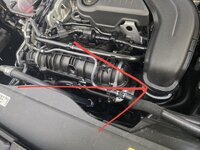

Did the pressure test also test the pressure relief cap?
Normally they pressurise the tank - which avoids the cap - so would never find a leaking cap!
If your cap leaks - coolant will overflow around your tank.
I have had a weak pressure relief spring in my cap - meaning it can't hold the full cooling system pressure, and it released at something like half the rated pressure - and also had my new cap with what must have been a cheap/crap o-ring, which started leaking after a year (The o-ring went flat)
Normally they pressurise the tank - which avoids the cap - so would never find a leaking cap!
If your cap leaks - coolant will overflow around your tank.
I have had a weak pressure relief spring in my cap - meaning it can't hold the full cooling system pressure, and it released at something like half the rated pressure - and also had my new cap with what must have been a cheap/crap o-ring, which started leaking after a year (The o-ring went flat)

A complete new bottle with new cap was fitted. Car booked in again with specialist next week.Did the pressure test also test the pressure relief cap?
Normally they pressurise the tank - which avoids the cap - so would never find a leaking cap!
If your cap leaks - coolant will overflow around your tank.
I have had a weak pressure relief spring in my cap - meaning it can't hold the full cooling system pressure, and it released at something like half the rated pressure - and also had my new cap with what must have been a cheap/crap o-ring, which started leaking after a year (The o-ring went flat)
Having visited the specialist again today, the current symptoms - with the new expansion bottle/cap - are the same as with the old bottle. There is dried residue of coolant around the bottom of the bottle. I'm told that this is a sign that the system is becoming overpressured. What could it be? There's no sign that the car is overhesting. Specialist says that thermostats, water pumps and blown head gaskets would be unusual. Suggested that a blocked heater matrix might be the issue. Any thoughts?
If its spewing out coolant, then there is too much pressure indeed in the cooling circuitHaving visited the specialist again today, the current symptoms - with the new expansion bottle/cap - are the same as with the old bottle. There is dried residue of coolant around the bottom of the bottle. I'm told that this is a sign that the system is becoming overpressured. What could it be? There's no sign that the car is overhesting. Specialist says that thermostats, water pumps and blown head gaskets would be unusual. Suggested that a blocked heater matrix might be the issue. Any thoughts?
- Check the coolant temp when driving. Too high? Thermostat might be stuck and/or pump might be broken
- Is there a trickle/stream from the smallest top connection of the coolant tank? If not > pump might be broken
- Blocked heater matrix is possible for sure, I believe people hear gurgling noises in the cabin when they have this issue
- Headgasket? Buy one of the kits that you stick in the top of the expansion tank to see if you have exhaust gases in the coolant
Thank you. Things that even I might be able to check. For info. The car seems to run at normal temperature.
Having visited the specialist again today, the current symptoms - with the new expansion bottle/cap - are the same as with the old bottle. There is dried residue of coolant around the bottom of the bottle. I'm told that this is a sign that the system is becoming overpressured. What could it be? There's no sign that the car is overhesting. Specialist says that thermostats, water pumps and blown head gaskets would be unusual. Suggested that a blocked heater matrix might be the issue. Any thoughts?
You do have a complicated pump/cooling system/electronic thermal module - so you do not have a 'simple' thermostat.
This has various phases depending on an ECU control - Have you scanned for fault codes?
The matrix is number 2
Coolant pump with engine thermal management system module GX33 is number 9 - depends on how this module is plumbed internally - if the matrix is in series with the head then this could cause overheating (and expelle coolant out the tank) - but if its in parallel I don't think it could.
If you have a blocked matrix you would normally get a temp difference from your left and right vents?
FYI From here:
View document [SSP 555 Двигатели 1,5 л 96110 кВт TSI семейства EA211 EVO]
vd Veer engineering car electronics. Haldex, DSG, CAN controller and other CANBUS devices.
Operating strategy of the thermal management system
The operating strategy of the thermal management system depends on many different factors.
These include, for example, the speed and torque, the fastest possible engine warm-up, the heating requirement, and high or low outside temperatures.
The engine thermal management system module is activated in different phases, which depend on whether the ignition is on or off, whether the engine is "cold" or "warm", and whether the coolant temperature is regulated in the range from 85 to 105 °C.
Phase 01 Initial position with ignition off If the ignition has been off and a certain time has elapsed (see phase 05), rotary flap 1 moves to a position in which the path for coolant to the radiator is closed. Thanks to this, the coolant remains in the engine and cools down more slowly. If there is still residual heat when the engine is restarted, the engine will reach its operating temperature more quickly.
Phase 02 Initial position when the ignition is switched on and the engine is started
To warm up the engine as quickly as possible, both rotary flaps are completely closed.
The coolant remains in the engine (does not circulate) and quickly heats up from the heat of combustion. The coolant pump operates, but does not supply coolant.
Phase 03 Warming up the engine to a coolant temperature of 85 °C
In this phase, both rotary flaps open individual channels to various components in the following order:
1 Cylinder head, engine oil cooler and heater heat exchanger
2 Expansion tank supply
3 Cylinder block
4 Coolant radiator
Phase 04 Coolant temperature regulation to 85–105 °C
After the engine has warmed up, the coolant temperature regulation begins, depending on the operating mode.
This regulation is carried out exclusively via rotary flap 1. Rotary flap 2 is fully open and remains in this position. The coolant temperature is maintained at 105 °C at low load and speed, and is reduced to 85 °C at high load and speed.
Regulation is carried out steplessly according to programmed parameters
Phase 05 Ignition off and diagnosis
After the ignition is switched off, both rotary flaps are fully opened for a certain time.
The duration of this operating time after the ignition is switched off depends, for example, on the activation of the charge air cooling pump V188 and the radiator fan VX57. Then the engine temperature control module performs a diagnosis of the end positions. In this case, the rotary flaps are first moved to the fully open position, then to the mechanical stop of the fully closed position and the fully open position.
Finally, the engine temperature control module moves rotary flap 1 to the "coolant radiator closed" position. In this position, rotary flap 2 remains fully open
Similar threads


- Replies
- 4
- Views
- 2K