mechanic has checked it out, and seems to be bottom end seizure.

so prob new engine.
 
Personally, I wouldn't clean an intercooler on the car, I'd take it off.

However, I've seen online guides that suggest using kerosene poured through the intercooler... where do you think you went wrong? :(
 
I removed the oil from the intercooler by cleaning with paraffin, but didnt remove all the paraffin.

to be right, i should have blew it out with an airline or used a hairdrier.

the turbo sucked the remaining paraffin up.

damm..........
 
Sorry to hear this, its never nice to hear of a destroyed engine, especially after you were trying to improve it.

The turbo is before the intercooler (which is there to cool down the compressed, hot, charge air), and is active all the time, though boost will not be felt until about 1600 rpm and above. So I think it was just the fact that the engine warmed up enough to get the paraffin vapourised and drawn into the cylinders. The result is runaway, the engine revs rise even though you've taken your foot off the pedal.

Did you try switching off? There has been speculation here recently that the anti-shudder valve should block the inlet at switch-off and strangle a runaway engine. It would be useful to know what happened in a real case.

I don't know enough to say if it was liquid paraffin getting into the cylinders or just the effects of runaway, the engine revving itself to death. Paraffin isn't that different to diesel oil as a fuel for a diesel engine, and coming from the intercooler will be out of the ecu's control
 
have got a replacement engine. my engine was a asv 110.

the one i got is a AGR, is it the same spec or is it a 90 bhp
 
Since my last post, the replacement engine has been fitted.

agr 90bhp from a bora.

Hopefully someone can help, when i turn car ignition off, the anti shutter valve doesnt close, wheich means the car has an abrupt stop.

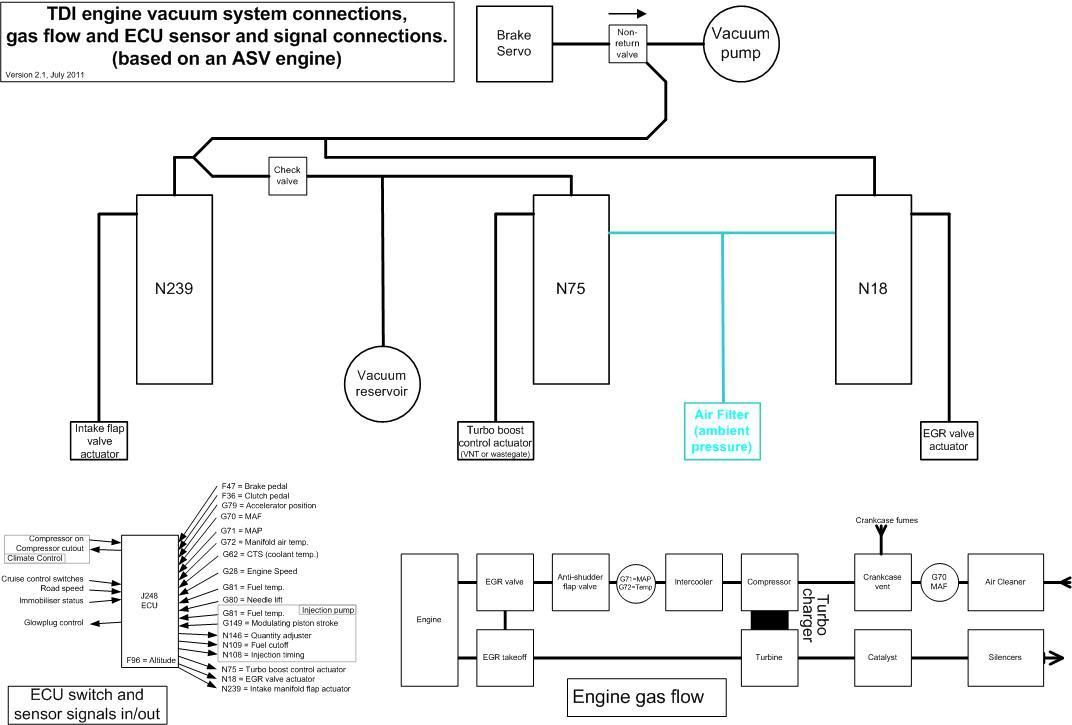
the valve remains in the open position all the time. Can anyone have a diagram of the layout of the vacuum pipes or point which pipe should be closeing the valve.
 
the anti shutter is connected to egr valve. normally when engine is turned of the valve would close, and shut down engine
 
nathal wrote

the anti shutter is connected to egr valve. normally when engine is turned of the valve would close, and shut down engine

No, it isn't. The anti-shudder valve is mounted in the same piece of pipe as the EGR valve but functions completely separately.

There is a solenoid valve, N239, which applies vacuum to the anti-shudder flap valve for about 3 seconds as soon as the ignition is switched off. This is mounted on the intake manifold. There should be a vacuum pipe to the N239 and another from the N239 to the anti-shudder valve acutator.
AGR engines were fitted to Toledos as well as Boras, and the vacuum system should be the same as your 110.
 
any ideas why the anti shudder isnt operating. have you a diagram showing layout of the pipes, so i can check they connected to the right places.

also with the new engine being fitted, the temperature reading, on trip computer is showing wrong temperature. there is also a louder drone from the engine when in turbo
 
I traced the vacuum pipes on my engine (ASV) some time ago and put together this diagram. Your AGR has a wastegate turbo rather than a variable vane type. That may be enough to change the layout of the pipes, I don't know for sure. They are difficult to photograph, being pushed together at the back of the engine compartment.

TDIvacsys.jpg


For added value, there's a block diagram of the gas flow through the engine and an attempt to list all the signals coming in and out of the ECU.
 
the engine was changed from a asv to agr, but the same turbo was kept. prob the turbo should have been changed but it wasnt
 
problem solved.

checked the pipes and one was kinked, stopping the air flow. now the anti shutter works again.

will see if this affects the digital temp readout, as it isnt reading correct
 
<nitpick> anti-shudder </nitpick>

ASV has a VNT turbo, AGR expects a wastegate turbo. Which ECU are you using, the original one (ASV) or one that came with the new engine (AGR)?

I think that if you've swapped the engine assembly (block and head) but kept the inlet and exhaust pipework and ECU from the ASV, then you should be OK, and the assembly should behave like an ASV. But I'd want some confirmation from someone with better knowledge of VAG engine specs.
 
Last edited:
can anyone tell me where the temperature sensor is, that shows on digital trip computer.
 
Colocated with the coolant temperature sensor that feeds the ECU, but separate from it. The connector has four wires, which is the clue :)

It's screwed into a metal coolant manifold attached to the right-hand (nearside in UK) end of the cylinder head.
 
Last edited: