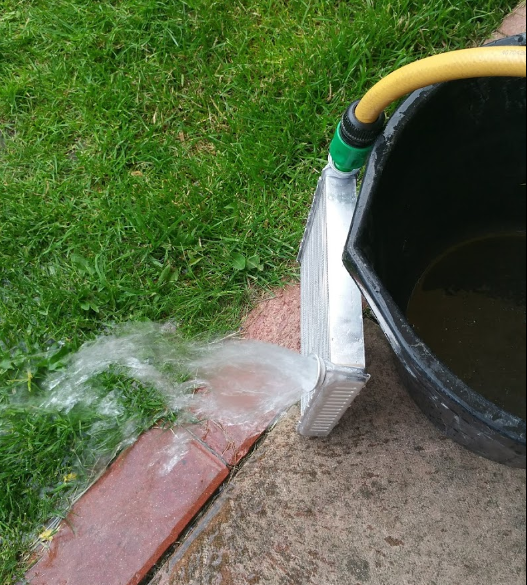
Finally received my new heater matrix - even just blowing through it you could tell the old one was restricted.
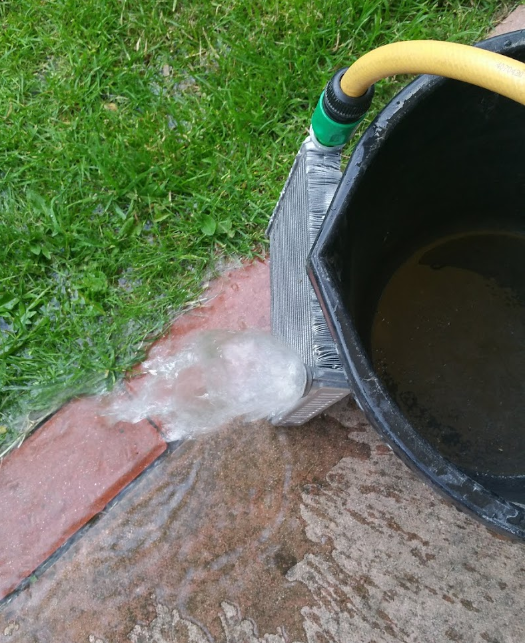
Thought I would do a simple hose test of old and new and you could also see a difference in flow.

OLD vs NEW
1623658356958.png
1623658329224.png


when I fitted it I started the engine to circulate the coolant and check I had no leaks, all was fine. BUT I noticed when I switched my engine off only after 5 mins of idling I could just hear the small electric pump pumping coolant through the micro circuit of the heater matrix and EGR cooler - flowing coolant through the heater matrix, with a partially restricted heater matrix this small electric pump will struggle to flow coolant arround this micro circuit and its easy to think after a DPF regen there will be a lot of heat in the EGR cooler that can't flow to the heater matrix and so locally boils and expels through the header tank cap!
I have noted previously after stopping after a drive that my main fans are on for a fair amount of time! Enough for me to think - wow my fans are still on (minutes later) - my theory that after a DPF regen and I stop - there will be a temperature sensor somewhere near the EGR cooler 'waiting' for the micro circuit to bring the temps down before it switches off? and with restricted heater matrix it can't or will take longer? Anyway i'll keep an ear out see if the improves?
 
Another point I noticed was the price variation in heater matrix between the winter and summer!
when I last looked at getting a new heater matrix - would have been November time I could not find a single one for less than £90!
Now You can see the cheapest (aftermarket) one's around £25!
I'm sure this same but opposite for AC parts!
 
Dear @SuperV8,

I just found your post through Google and wanted to thank you for the extremely detailed information you shared. I have a 2016 Passat B8 2.0 TDI in France with the same EA288 cooling system nightmare.

Back in 2021, I had what I now believe was the classic G13 silica bag failure. I first noticed it after the heater matrix stopped working. The dealership replaced the heater core but never addressed the root cause. Unsurprisingly, the new matrix clogged again about two weeks later.

When I questioned them further, I discovered they did not even have the VAG coolant flushing machine. Their “repair” procedure was simply draining the coolant and refilling the system with vacuum fill. After paying for repeated heater core replacements with no actual diagnosis, I stopped going back there.

Since then, I have tried to clean the system properly myself. I drained the coolant from all three drain points according to the workshop manual, but as you know, that only removes roughly half of the coolant from this engine. I then repeatedly filled the system with distilled water using a vacuum filler and performed around five complete fill/run/drain cycles before finally refilling with concentrated G12 Evo to achieve approximately a 50/50 mix.

The worrying part was that every single drain produced a large amount of black/brown debris and sludge. After doing more research, I realized the dealership had refilled the system with G12 Evo after the heater core replacement while a large amount of old G13 residue was still inside the engine. I suspect the mixture of degraded G13 contamination and G12 Evo created the brown sludge that eventually cooked inside the EGR/oil cooler circuits and heater core.

Even after all those flushes, I still could not fully eliminate the contamination. I have been forced to reverse flush the heater core every couple of months just to maintain cabin heat.

Recently I noticed there was no coolant flow visible in the expansion tank return hose. After investigating further, I found both the return hose and the non-return valve on top of the oil cooler circuit (#1 in the schematic) heavily clogged with debris. I cleaned the hose and valve thoroughly and found even more contamination trapped inside the oil cooler passages. After reassembling everything and running the VCDS bleed procedure again, the return flow finally came back and the thermal management system started behaving normally again, including after-run pump circulation.

Ironically, one day later the heater core partially clogged again, which makes me think restoring proper circulation liberated a lot of debris that had been trapped in stagnant areas of the system for years.

Interestingly, despite all of this, I never experienced overheating or abnormal oil temperatures. My theory is that many of these small bleed/restrictor/check-valve circuits gradually became restricted over time while the main cooling circuit remained functional enough to avoid major thermal issues.

At this point I honestly feel exhausted with this engine. If you have any suggestions for finally eliminating the remaining contamination permanently — especially considering how sensitive/OCD I am about keeping the cooling system clean — I would greatly appreciate it.

Thanks again for all the helpful information.

Capture-d-ecran-2026-05-18-133504.png
Image 2026-05-20 at 09.04.28.jpeg
 
  • Like
Reactions: SuperV8
They are too complicated aren't they! Fine when they are working - but a nightmare when they aren't!

Is your 'only' problem - lack of heat in the heater matrix? or is there another problem?
Do you get any heat on some vents Left or right - or no cabin heat at all?


Others on here have found clogged electric pumps (the small electric support pump on the micro EGR/matrix circuit) and also lots of debris behind the thermostat, so i'd recommend removing your stat - and flushing the block, and fitting a new stat.

Have you had a new cam belt and coolant pump yet? Our coolant pumps are mechanically driven from the cam belt - with an electrically actuated shroud, to block of the pump impeller to reduce coolant flow to speed up the engine warm up phase. These shrouds can stick closed, reducing your pump pumping capacity.

Also your 'debris' looks very black - don't remember anything like that in my system - when I went through a couple of years of flushing my matrix and the 'debris' was always light coloured, like sand or limescale.

Does your engine use and oil of coolant?

1779262727066.png
 
They are too complicated aren't they! Fine when they are working - but a nightmare when they aren't!

Is your 'only' problem - lack of heat in the heater matrix? or is there another problem?
Do you get any heat on some vents Left or right - or no cabin heat at all?


Others on here have found clogged electric pumps (the small electric support pump on the micro EGR/matrix circuit) and also lots of debris behind the thermostat, so i'd recommend removing your stat - and flushing the block, and fitting a new stat.

Have you had a new cam belt and coolant pump yet? Our coolant pumps are mechanically driven from the cam belt - with an electrically actuated shroud, to block of the pump impeller to reduce coolant flow to speed up the engine warm up phase. These shrouds can stick closed, reducing your pump pumping capacity.

Also your 'debris' looks very black - don't remember anything like that in my system - when I went through a couple of years of flushing my matrix and the 'debris' was always light coloured, like sand or limescale.

Does your engine use and oil of coolant?

View attachment 54232
Wow, thanks a lot for the fast and detailed reply.

At the moment I still have proper heat on the driver side (French-spec LHD car) and weak/lukewarm heat on the passenger side. Every time I reverse flush the heater core, the heating performance comes back almost completely, but after a couple of months the passenger side gradually starts losing heat again.

So far I have no noticeable coolant loss or oil consumption, oil temperatures remain normal (around 95–105°C on long highway drives), and the engine has never overheated.

After recently discovering the clogged return hose and clogged non-return valve on the oil cooler circuit, I’m now starting to think a lot of debris has probably remained trapped in stagnant/low-flow areas of the cooling system for years and is gradually being released back into circulation.

I’m considering trying Liqui Moly 3320 Radiator Cleaner and then doing a more aggressive “old-school” continuous flushing method by routing the expansion tank return hose into a bucket and flushing repeatedly with plenty of distilled water while circulating the system, hoping to remove as much suspended debris as possible. With normal drain/refill procedures, I feel like a large amount of contamination simply remains trapped inside the system.

At this point I’m mainly trying to figure out the safest way to finally remove the remaining debris without damaging the heater core again.
 
Couple of posts you might find interesting:


Think I would look at doing another flush, changing your thermostat (will help the block flush with the stat removed) and fitting a new matrix (after the flushing)
I know you have had a new matrix - but sounds like your matrix is still partially blocked/contaminated. I find the matrix prices very seasonal, so shouldn't be too expensive going into summer. NRF, Nissens or Valeo seem good.
 
I’m considering doing one final complete flush because of the amount of debris/restrictions I already found in the low-temperature and bleed circuits.

This time I’m thinking about using 2 bottles of Wynn’s 45941, since according to the product documentation it is specifically intended to help dissolve/remove old G13 silicate contamination and coolant residues. Wynn’s recommends driving around 50 km after adding the product.

After that, instead of simply draining from the radiator and auxiliary pump hoses again, I’m considering using a continuous flushing method: disconnecting the expansion tank return hose, routing it into a bucket, and continuously feeding distilled water into the expansion tank while the engine is running until at least 20 liters have circulated through the system.

My reasoning is that with normal draining, the coolant exits too quickly from the lower drain points and I suspect a lot of suspended debris remains attached to side walls or trapped in low-flow areas. With continuous circulation/overflow flushing, I’m hoping to keep more particles suspended and carry them out gradually.

After that I’m also considering replacing the heater core as a preventive measure.

What do you guys think? Does this sound reasonable on the EA288 cooling system, or am I overdoing it at this point?
 

Attachments

  • W45941_TDS_EN (1).pdf
    192.1 KB · Views: 22
I’m considering doing one final complete flush because of the amount of debris/restrictions I already found in the low-temperature and bleed circuits.

This time I’m thinking about using 2 bottles of Wynn’s 45941, since according to the product documentation it is specifically intended to help dissolve/remove old G13 silicate contamination and coolant residues. Wynn’s recommends driving around 50 km after adding the product.

After that, instead of simply draining from the radiator and auxiliary pump hoses again, I’m considering using a continuous flushing method: disconnecting the expansion tank return hose, routing it into a bucket, and continuously feeding distilled water into the expansion tank while the engine is running until at least 20 liters have circulated through the system.

My reasoning is that with normal draining, the coolant exits too quickly from the lower drain points and I suspect a lot of suspended debris remains attached to side walls or trapped in low-flow areas. With continuous circulation/overflow flushing, I’m hoping to keep more particles suspended and carry them out gradually.

After that I’m also considering replacing the heater core as a preventive measure.

What do you guys think? Does this sound reasonable on the EA288 cooling system, or am I overdoing it at this point?
When I had my heater matrix block up I changed it myself. I had just had the faulty water pump changed (had cam belt done at same time) and also new thermostat and housing (the car was overheating and it was hard to diagnose what was at fault. Turned out it was the water pump).

As a lot of the coolant had therefore been replaced, I did not fully drain or bleed the coolant system. I just did old school fill it up and give the rad hose a squeeze. Topped it up for a few days after driving it and it was good to go. The matrix has been good for 5+ years now.

You seem to have more gunk in your system and like you say, that could be due to coolants being mixed together. I did not have the same problems. As you've mentioned, you could have released more stuff and it's working it's way around the system. I'm not sure how to fix that other than flushing it like you suggest. I know that my thermostat housing had collected quite a lot of debris when mine was changed.

No idea about the Wynss 45941 but worth a try if you think it can help.

I would only replace the hear core/matrix once you are happy the system is clean.

Good luck with it!