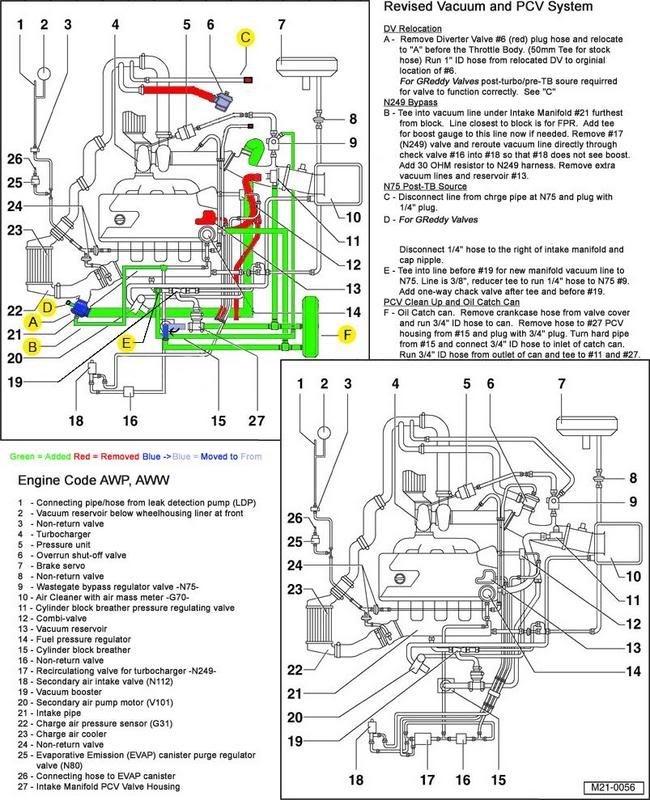
Thats the way I had mine done first time around, but I noticed there was still vac in the system of pipes that go in and out of N249, so maybe it was just a partial bypass???
Anyway, I have now totally ripped off all pipes to N249 and N112 and thus eliminated a fair distance of pipework within which leaks could develop. As for my "partial bypass" theory, I don't know if there's any truth in it but I know that my car felt crisper after totally ripping out allthe pipes. Could have just been because I eliminated so much unused pipework.
Also, there are 2 hoses coming from the inlet mani, one goes to TB, other to N249 area. perhaps if you leave the one to the FPR as is, and just lead the other one to the DV straight, it would eliminate the following completely: N249, N112, vac res and about 3 metersof pipework.
Just though, aren't we boring? its 23.00 on christmas eve, and were discussing the benifits of thevacuum reservoir on the VAG 1.8T engine.
For what it's worth, on the TDI 110 engine the vac pipes go to the N239 (on this engine it controls the intake flap valve, the anti-judder valve), the N75 (turbo vane control) and N18 (EGR valve).
The vacuum for everything, brakes included, is provided from a vacuum pump driven off the camshaft, there is no manifold tap.
The brake servo has its own, substantial, reservoir and is protected by a one-way valve from being depleted once the engine has stopped.
The EGR valve is inactive at low revs. The turbo vanes should be pulled right in at low revs, so the vac reservoir will help. The intake flap defaults to open and is only pulled shut briefly when the engine is turned off - in this case the reservoir is vital.
Obviously its a bit different for petrol engines, though.
anyone got a pic of this on a lcr, just cant grasp what to remove and put where, usually pretty good with this sort of thong but looks different on the beeza
RickC i'm in the same boat as you normally i'd just dive in and have a go but i'm a little confused as what to put where and what not what to put where. I dont want to be killing the engine. the How to on the Beeza uses resistors and allsorts....
Am I right in thinking nothing needs to be done to the electrics (resistors or anything) on the LCR, just leave the electrics connected but not doing anything? Is that thing the map sensor?
This site uses cookies to help personalise content, tailor your experience and to keep you logged in if you register.
By continuing to use this site, you are consenting to our use of cookies.