Nautilus

Active Member
Dec 9, 2006
547
2
Bucharest, Romania
Hello everyone

I'm going to try a little experiment to improve the handling and steering response, but for this I need to know which kind of bushings does the Leon Cupra/FR (with 1.8T engine) have on the front subframe. There are two types on Golf IV platform, the one-piece bush(2 per car) found on Golf and two-piece bush (4 per car) on the TT Roadster model and some other TTs

Anyone who has reliable information is welcome. A picture would be worth 1000 words :)

If possible, we should gather here the information for various Leon Mk1 versions, Cupra, FR, Cupra R

Thanks everyone

~Nautilus
 
Not wishbone, subframe. Behind the rear wishbone bushings there are the bushings which connect the front subframe to the floor, with a screw through them and a large washer. The official name may be "subframe mount"

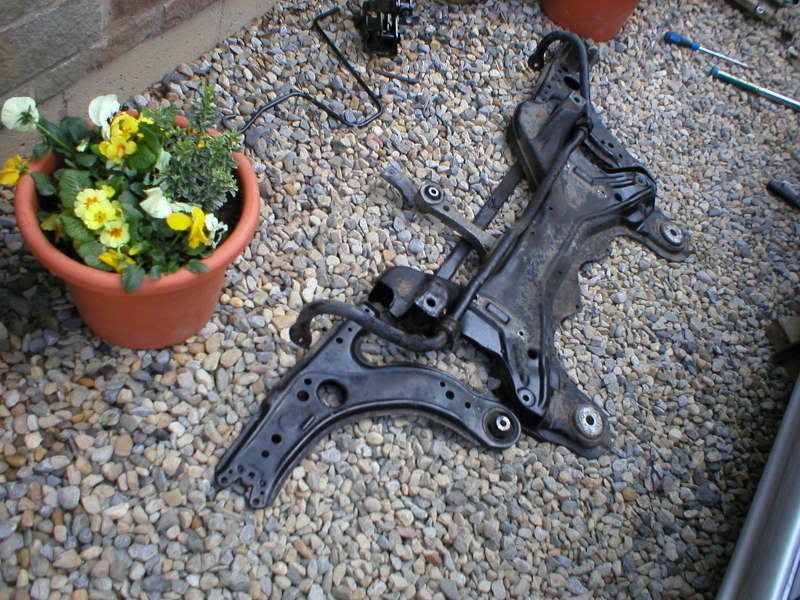
This is the Golf IV subframe detached, with mounts fitted (white)

subfra6.jpg


~Nautilus
 
The idea behind the experiment is the following

For 2 years I've been experimenting with dogbones, motor mounts, alignment settings, etc. trying to get the front end of my 337 to stop understeering and plowing. I had a '92 Jetta GLi that cornered on rails, so I couldn't believe a 337 couldn't do it too. When I'd go real stiff with dogbone bushings and/or tranny & motor mount, the bite of the front end improved alot but the noise was unbearable. After endless experimentation I realized something important. When I stiffened up motor mounts or dogbone bushings it's wasn't the reduced engine movement that improved handling (think about it, why would it be?), it was the engine acting to reduce movement of the subframe through the dogbone! A few months ago I removed the subframe from my 337. I was amazed at how flexible the whole thing was and how wimpy the rear subframe bushings were. The subframe and these bushings are the key to getting a MKIV to stop understeering! Those that say "improve your handling by limiting engine motion with our poly dogbone bushings/motor mounts" have it completely backward. It's not less engine movement that aids handling, it's less subframe movement.

When I had the subframe out, I strengthened it by welding steel bar-stock braces inside and outside. This helped, but the biggest change came from making new rear subframe bushings. It took a lot of trial and error so I can't provide detailed instructions here, but I took polyurethane boat trailer rollers and turned them down on the shaft of a bench grinder. A slightly oversized top and bottom half are put in the subframe then squeezed to hold the subframe tightly when the bolt is torqued down.
I'm back to a stock dogbone mount and don't need anything tighter. The interior isn't as quiet as stock, but it's far better than with poly dogbone bushings.

What a change in the handling! The steering is far more accurate than my brother's M3 and the front end just won't give up in corners. I can throw the tail out any time I want, or balance it in a 4 wheel drift. Hard accleration creates no front end lift. None. When I get wheel spin, it's both front wheels equally with no wheel hop at all. I just can't believe that all of the other MKIV tweakers out there have missed this one.

If you're comfortable fabricating and experimenting, give it a try.


Source: http://forums.vwvortex.com/zerothread?id=2505543

Now, I'm not skilled in machining, leave alone polyurethane machining, and I don't trust poly bushings to be the ultimate solution, but on the same thread has been suggested the possibility to replace the original aluminium/rubber subframe bushings, which had been one-piece type, with the two-piece format from the Audi TT Roadster, which are harder, have less rubber around the aluminium core (about 1mm thick compared to the 5mm for the stock one-piece bushes) and are easier to fit. As hard rubber is less prone to vibration than polyurethane, it should have been a less risky experiment.

However, the original discussion had been around a Golf Mk IV and what I would wish to know before ordering the bushings is what type the Seat Leon has, the "Golf-like" or the "TT-like"...

~Nautilus
 
This is a good thread at the right time for me too
I've just spent 2 days reading through the stickiesw on vortex till I'm cross eyed
I'm going to try the stiffening of the front sub frame with one of the mentioned assemblies or one made by myself.
As for the bushings it'll be interesting what people will come up with about this. Does the R have the same bushings as the TT??
And what are the LCA (lower control arm) bushes??
 
LCA bushes are visible in the picture posted by DPJ, on the rear tip of the control arm, where it meets the subframe. There are also bushes on the front tip of the control arm. Both can be replaced with Powerflex poly bushings, but I would not take the risk

Can the subframe bushings/mounts be changed with the subframe on the car (first one side, with support at the middle, than the other)? To fit the two-piece TT bushings should be no problem but pressing or drilling out the one-piece would not be an easy job unless the frame is removed... but when someone reads "more accurate steering than a M3" it's a bit too tempting

~Nautilus
 
Last edited:
Can the subframe bushings/mounts be changed with the subframe on the car (first one side, with support at the middle, than the other)? To fit the two-piece TT bushings should be no problem but pressing or drilling out the one-piece would not be an easy job unless the frame is removed... but when someone reads "more accurate steering than a M3" it's a bit too tempting

~Nautilus

It's not hard to drop the subfame and remove. I'd like to get another, get it powdercoated and refit.
 
Changes in camber, different ARB and apparently a tighter lock - although i'd have thought a different rack would be needed for that. The main difference was in the geometry from the posts i'd read?
 
Interesting.

But...
Do not--I repeat--do not attempt to use cheap, hardware-store canned foam. This is not the same thing, and if injected into your chassis, will form a gummy mass that won't dry. Foamseal foam is a professional grade foam, which although it is a little unforgiving to cleanup mistakes, has superior mechanical properties and catalytic curing so it will dry even in an enclosed space.
 
"you must remember the wires and other lines that pass through the chassis must be relocated or they will be entombed forever."

I like this statement.

Having read through this it makes me think that this would be very difficult to do well. If the foam expands in 1 minute how can you tell that you have an even spead of this foam filling all areas equally?
Stiffening is an area that I'm very interested in but not this route.
I'm going the convential routew of tie bars.
I'm looking into the possibility of instead of getting fixed length bars get ones with variable lengths so it can be stiffened as needed for various applications